Organic Chemistry
Master the fundamentals of carbon compounds, functional groups, and reaction mechanisms essential for the health sciences.
Isomers & Stereochemistry
Sign in to track progress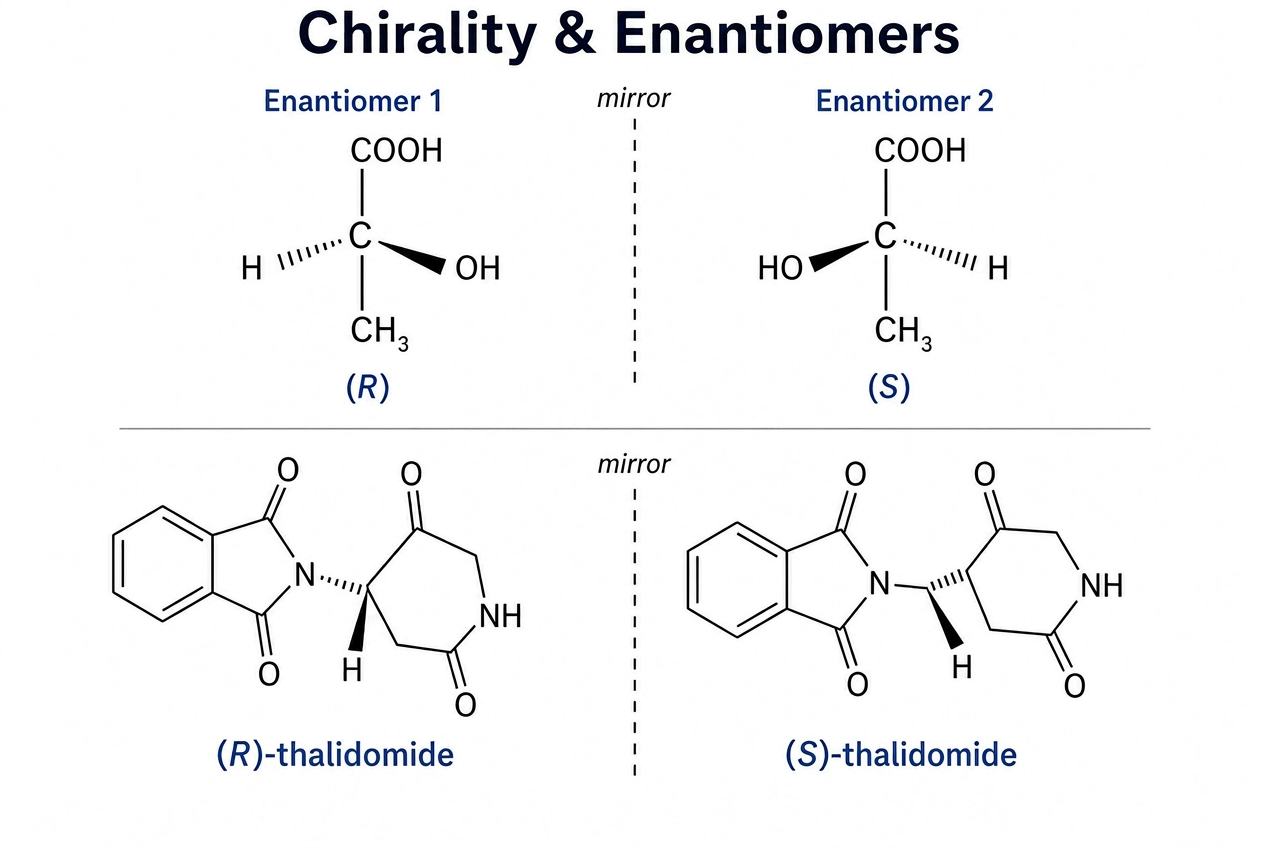
Isomers
Isomers are different compounds that share the same molecular formula but differ in how their atoms are arranged. Recognizing the type of isomerism is important because isomers can have different physical, chemical, and biological properties.
Constitutional (Structural) Isomers Constitutional isomers have the same molecular formula but differ in the connectivity of their atoms—that is, which atoms are bonded to which. Butane and isobutane (both C₄H₁₀) are constitutional isomers. They often have different physical and chemical properties.
Stereoisomers Stereoisomers have the same molecular formula and the same connectivity but differ in the three-dimensional arrangement of their atoms. Major types include enantiomers and diastereomers.
Chiral Centers (stereocenter) A chiral center (stereocenter) is a sp³ carbon atom bonded to four different substituents. Such a carbon can give rise to non-superimposable mirror-image structures.
Examples:
- CH₃CH(F)CH₂CH₃ → central CH(F) carbon has four different substituents → chiral center.
- CH₄ → four identical substituents → no chiral center.
Enantiomers Enantiomers are stereoisomers that are non-superimposable mirror images of each other. In an achiral environment, they generally have identical physical properties such as melting point and boiling point, but they rotate plane-polarized light by equal amounts in opposite directions. Enantiomers can interact differently with chiral biological targets such as enzymes and receptors.
Racemic Mixtures A racemic mixture contains equal amounts of two enantiomers (50:50). Because the two enantiomers rotate plane-polarized light by equal amounts in opposite directions, their rotations cancel. Therefore, a racemic mixture is optically inactive overall.
Diastereomers Diastereomers are stereoisomers that are not mirror images of each other. In molecules with multiple stereocenters, they can result when configurations differ at one or more—but not all—stereocenters. Unlike enantiomers, diastereomers generally have different physical and chemical properties.
Geometric (cis/trans) Isomers Geometric (cis/trans) isomers are stereoisomers caused by restricted rotation around a carbon-carbon double bond (C=C) or within a ring.
- cis: Similar groups are on the same side.
- trans: Similar groups are on opposite sides.
These molecules have the same molecular formula and connectivity but differ in their three-dimensional arrangement.
Conformational Isomers (Conformers/Rotamers) Conformational isomers are different three-dimensional arrangements produced by rotation around single bonds, such as the staggered and eclipsed conformations of ethane. Unlike configurational stereoisomers such as enantiomers and cis/trans isomers, conformers generally interconvert through rotation around single bonds without breaking covalent bonds. Rotamers are conformers that specifically differ by rotation around a bond.
Identifying Isomers When comparing two molecules:
- Different molecular formulas → Not isomers.
- Same formula, different connectivity → Constitutional isomers.
- Same connectivity, different 3D arrangement → Stereoisomers.
- Mirror images that cannot be superimposed → Enantiomers.
- Not mirror images but still stereoisomers → Diastereomers.
Isomer Classification Reference Table
| Pair | Classification |
|---|---|
| Butane & isobutane | Constitutional isomers |
| (R)-Lactic acid & (S)-lactic acid | Enantiomers |
| cis-2-Butene & trans-2-butene | Geometric isomers (diastereomers) |
| (2R,3R)-2,3-Butanediol & (2S,3S)-2,3-butanediol | Enantiomers |
| Staggered & eclipsed ethane | Conformers |
Key Points
- Constitutional isomers differ in connectivity; stereoisomers differ in 3D arrangement
- Enantiomers are non-superimposable mirror images; diastereomers are stereoisomers that are not mirror images
- A racemic mixture contains equal amounts of both enantiomers and is optically inactive overall
- Rotamers result from rotation around single bonds and interconvert without breaking bonds
- A common chiral center is an sp³ carbon bonded to four different substituents
- Geometric cis/trans isomers result from restricted rotation and are a type of stereoisomer; cis/trans pairs are generally diastereomers