Organic Chemistry
Master the fundamentals of carbon compounds, functional groups, and reaction mechanisms essential for the health sciences.
Functional Groups
Sign in to track progress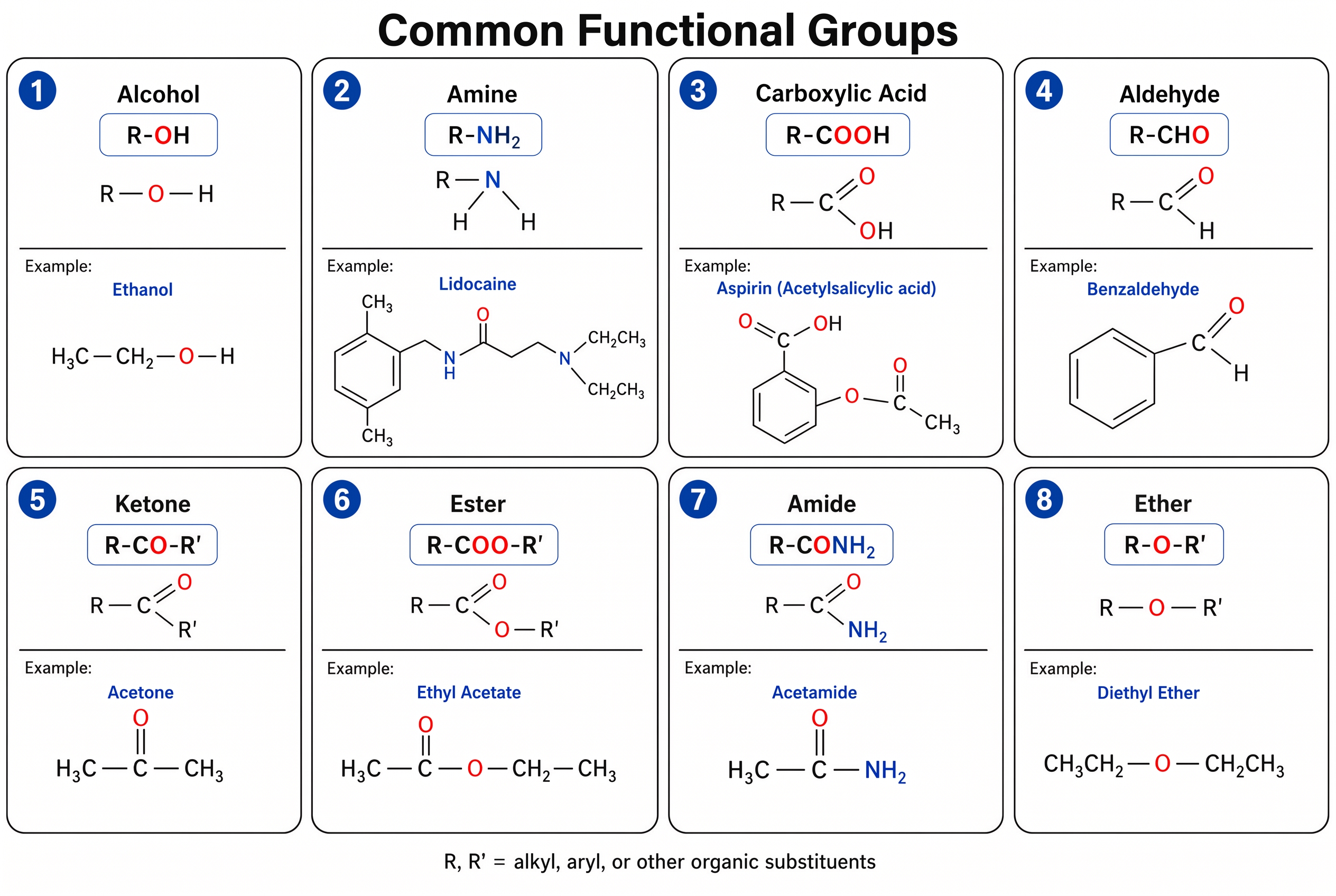
Functional groups are specific groups of atoms within molecules that are responsible for the characteristic chemical reactions of those molecules. Recognizing functional groups is critical because they determine how a molecule behaves chemically and interacts with biological systems.
Hydroxyl Group The hydroxyl group (-OH) is an oxygen bonded to a hydrogen. When attached to a saturated carbon it defines an alcohol ("-ol"). It is polar and acts as both a hydrogen bond donor and acceptor, which increases water solubility.
Alcohols (-OH, "-ol") Alcohols contain a hydroxyl group bonded to a saturated carbon. The hydroxyl increases water solubility and acts as a hydrogen bond donor and acceptor. Common examples include ethanol and menthol.
Carbonyl Group (C=O) A carbon atom double-bonded to oxygen. Present in aldehydes, ketones, carboxylic acids, esters, amides, and acid chlorides. The carbonyl carbon is electrophilic, making it highly reactive.
Aldehydes (R–CHO, "-al") Aldehydes contain a carbonyl group bonded to at least one hydrogen atom (R–CHO). The carbonyl carbon is always at the end of the carbon chain. Aldehydes are readily oxidized to carboxylic acids and are common in fragrances and metabolic intermediates.
Ketones (R–CO–R', "-one") Ketones contain a carbonyl carbon bonded to two carbon atoms (R–CO–R'). The carbonyl carbon is located within the carbon chain. Many steroid hormones and common solvents (acetone) contain ketone groups. The polarity of the carbonyl makes it a key site for nucleophilic attack and allows the carbonyl oxygen to act as a hydrogen-bond acceptor.
Carboxyl Group The carboxyl group (-COOH) combines a hydroxyl with a carbonyl on the same carbon. It is acidic, readily donating its proton to form a carboxylate (-COO⁻), and defines a carboxylic acid ("-oic acid").
Carboxylic Acids (-COOH, "-oic acid") Carboxylic acids contain both a carbonyl and a hydroxyl on the same carbon (the carboxyl group). They are acidic and often exist as their conjugate carboxylate salt at physiological pH, which increases water solubility.
Esters (R–COOR', "-oate") Esters contain a carbonyl group bonded to an oxygen atom, which is in turn bonded to another carbon group (R–COOR'). They are formed from the condensation of a carboxylic acid and an alcohol. Esters are common in fragrances, flavoring agents, fats, and many biological molecules.
Ethers (R-O-R', "-ether" or "alkoxy-") Ethers contain an oxygen bonded to two carbons. They are relatively unreactive, slightly polar, and are common as solvents (diethyl ether) and structural fragments in many organic molecules.
Amines (primary RNH2, secondary R2NH, tertiary R3N, "-amine") Amines are derivatives of ammonia where one or more hydrogens are replaced by alkyl or aryl groups. Primary amines have one carbon substituent (RNH2), secondary amines have two carbon substituents (R2NH), and tertiary amines have three carbon substituents (R3N). Amines are basic and are commonly protonated at physiological pH, which affects their solubility and behavior in the body.
Alkenes ("-ene") Alkenes contain a C=C double bond. This site of unsaturation undergoes addition reactions and gives the molecule a planar (sp²) geometry at the double bond, affecting shape and reactivity.
Alkynes ("-yne") Alkynes contain a C≡C triple bond. This site of unsaturation is linear (sp) at the triple bond and, like alkenes, readily undergoes addition reactions.
Saturated Fats Saturated fats contain only C–C single bonds in their fatty acid chains. The straight chains generally pack more tightly together, so they are typically solid at room temperature (butter, lard).
Unsaturated Fats Unsaturated fats contain one or more C=C double bonds in their fatty acid chains. The kinks introduced by the cis double bonds prevent tight packing and lower the melting point, so they are typically liquid at room temperature (oils). Polyunsaturated fats have multiple double bonds.
Functional Group Reference Table
| Compound | Functional Group | Structure |
|---|---|---|
| CH₃CH₂OH (Ethanol) | Alcohol | R–OH |
| CH₃CHO (Ethanal/Acetaldehyde) | Aldehyde | R–CHO |
| CH₃COCH₃ (Acetone/Propanone) | Ketone | R–CO–R' |
| CH₃COOH (Ethanoic/Acetic Acid) | Carboxylic Acid | R–COOH |
| CH₃COOCH₃ (Methyl Ethanoate/Acetate) | Ester | R–COOR' |
| CH₃CH₂OCH₃ (Methoxyethane) | Ether | R–O–R' |
| CH₃CH₂NH₂ (Ethylamine) | Amine (primary) | R–NH₂ |
| CH₃CH=CH₂ (Propene) | Alkene | C=C |
| CH₃C≡CH (Propyne) | Alkyne | C≡C |
Key Points
- Aldehydes (R–CHO, "-al") have a carbonyl group bonded to at least one H; ketones (R–CO–R', "-one") have a carbonyl carbon bonded to two carbon atoms
- Esters (R–COOR', "-oate") form from a carboxylic acid and an alcohol and are common in fragrances, fats, and biological molecules
- The hydroxyl group (-OH) alone defines an alcohol ("-ol"); the carboxyl group (-COOH) is acidic ("-oic acid")
- Amines can be primary, secondary, or tertiary and are often protonated at physiological pH
- Ethers are relatively inert; alkenes ("-ene") and alkynes ("-yne") are sites of unsaturation
- Saturated fats have only single C–C bonds; unsaturated fats contain one or more C=C double bonds